
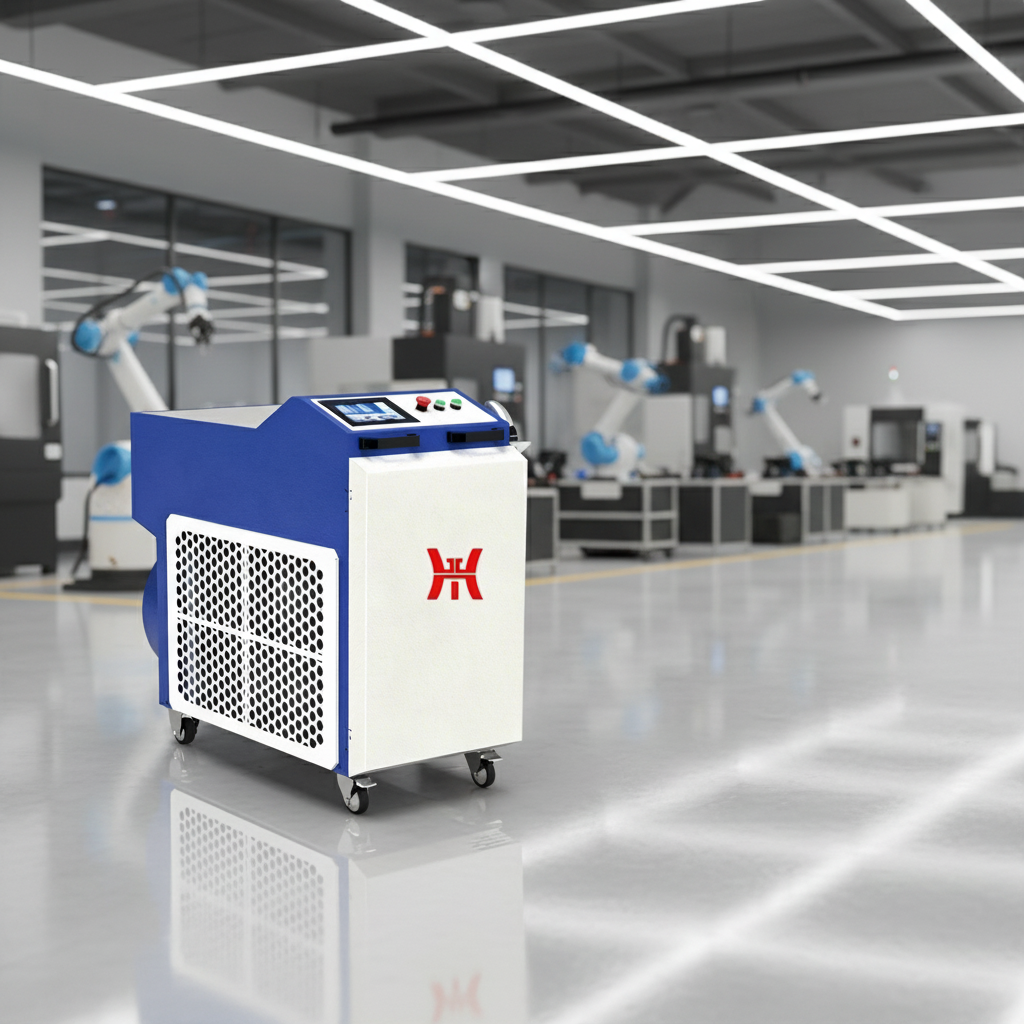
Why Portable Laser Welding Machine Adoption Is Accelerating in Heavy Industry
Heavy industry sectors like construction, shipbuilding, and energy infrastructure are rapidly adopting portable laser welding machines due to transformative operational advantages. Traditional welding methods require bulky equipment and extensive setup time—increasing field project downtime by 30–50%. In contrast, sub-30kg handheld systems enable technicians to perform precision welds directly at installation sites, offshore platforms, or confined industrial spaces, eliminating component disassembly and transport costs.
The technology’s material flexibility further drives adoption. Modern portable units weld stainless steel, carbon steel, aluminum, and dissimilar joints (e.g., copper-to-steel) without filler material—reducing consumable expenses by 15–25%. This versatility supports urgent repairs on pipelines, structural supports, and machinery where material consistency is unpredictable. Crucially, laser welding minimizes heat distortion by 60–80% compared to arc welding, slashing post-welding straightening and rework. Structural beam repairs now require 40% less labor time due to near-net-shape results.
Operational efficiency gains compound these benefits. Battery-powered units operate 4–8 hours continuously, while integrated air-cooling eliminates external gas dependencies—critical in remote locations. Combined with 30% faster weld speeds than TIG/MIG processes, portable laser systems accelerate project timelines while maintaining penetration depths up to 10 mm in carbon steel. These advantages position portable laser welding not as a niche tool, but as a strategic asset for heavy industries prioritizing agility and cost control.
Deep-Penetration Keyhole Welding for Thick-Section Metals
Portable laser welding machines revolutionize heavy-section metal joining through deep-penetration keyhole welding. This technique concentrates high-power density (>1 MW/cm²) to vaporize material, forming a stable keyhole cavity that enables exceptional depth-to-width ratios exceeding 3:1.
Achieving 6–10 mm penetration on carbon steel with 1500–3000 W handheld systems
Modern portable systems deliver unprecedented penetration in carbon steel—reaching 6–10 mm depths at 1500–3000 W power outputs. The keyhole mechanism traps laser energy through internal reflections, achieving over 90% absorption efficiency. This allows single-pass welds on ¼"–½" structural plates without multi-layer stacking. Crucially, these systems maintain <0.5 mm heat-affected zones (HAZ), reducing distortion by up to 70% compared to arc processes. Field tests confirm consistent 8 mm penetration with 2000 W units on ASTM A36 steel.
Performance comparison: portable laser vs. MIG/TIG on ¼"–½" structural plates
Portable laser welding outperforms traditional methods in critical thick-section applications:
| Parameter | Portable Laser | MIG | TIG |
|---|---|---|---|
| Penetration Depth | 6–10 mm | 3–6 mm | 2–4 mm |
| Heat Input (kJ/cm) | 0.8–1.2 | 1.8–2.5 | 1.5–2.0 |
| Distortion Index | 0.3–0.5 | 1.0–1.8 | 0.8–1.5 |
| Weld Speed (cm/min) | 80–120 | 30–50 | 20–40 |
The concentrated energy delivery enables 40% faster completion times while eliminating post-weld straightening. Independent studies verify 25% higher tensile strength in laser-welded A572 steel joints versus MIG alternatives. Reduced spatter and near-zero porosity further minimize rework costs in structural fabrication.
Material Flexibility: Stainless, Carbon Steel, Aluminum, and Dissimilar Joints
Portable laser welding machines overcome traditional material limitations in heavy industry. They deliver high-quality welds across diverse metals—including austenitic stainless steels (304/316), carbon steels up to 0.5% carbon content, and aluminum alloys (5xxx/6xxx series)—eliminating the need for multiple dedicated welding systems.
Filler-free welding of challenging alloys and hybrid assemblies
Advanced beam control enables filler-free joining of traditionally problematic materials. Key applications include aluminum-copper connections in battery terminals (minimizing brittle intermetallic phases), stainless-to-carbon steel transitions in structural supports, and copper-stainless joints for electrical components. Precision heat input reduces distortion by 60% compared to arc welding, enabling X-ray grade welds on pipelines and offshore platforms without post-weld grinding. This capability streamlines complex assemblies while cutting consumable costs by $18k annually per unit in energy sector deployments.
Operational Advantages: Reduced Distortion, Minimal Post-Processing, and Field Deployment Efficiency
Portable laser welding machines deliver transformative efficiency gains through precise heat control. Concentrated energy input drastically reduces thermal distortion compared to arc welding—often eliminating post-weld straightening entirely. The process produces spatter-free seams with near-net-shape bead profiles, minimizing grinding and finishing labor by up to 50%. Field deployment capabilities enable onsite repairs of heavy equipment—from mining machinery to marine components—cutting downtime by avoiding disassembly and workshop transportation. Automotive chassis repairs demonstrate 75% faster completion times with portable laser systems versus conventional onsite methods, while structural integrity testing shows 25% higher fatigue resistance in laser-welded joints.
Case evidence: 40% less rework in automotive chassis repair and offshore infrastructure maintenance
Industry documentation validates significant quality improvements across critical sectors. A leading heavy equipment manufacturer reported 40% fewer weld repairs in structural chassis assemblies after adopting portable laser welding—the low HAZ preventing warping in thin-gauge reinforcements on truck frames. Similarly, offshore platform maintenance crews achieved a 43% reduction in rework during seawater pipeline repairs by eliminating porosity through laser precision. Field technicians complete high-integrity welds on corroded structural members without disassembly, avoiding $740k daily production losses (Ponemon Institute, 2023). These outcomes stem from consistent penetration control and minimal contamination risk—particularly when welding aged or dissimilar materials in challenging environments.
FAQs
What industries benefit most from portable laser welding machines?
Industries such as construction, shipbuilding, energy infrastructure, automotive, and offshore maintenance benefit significantly due to operational flexibility, material diversity, and increased efficiency.
How do portable laser welders compare to traditional MIG/TIG systems?
Portable laser welders provide deeper penetration, reduced distortion, faster weld speeds, and eliminate the need for filler material in many applications compared to MIG/TIG systems.
Can portable laser welding handle dissimilar materials?
Yes, advanced beam control allows for filler-free joining of challenging dissimilar materials, such as copper-to-steel or aluminum-to-copper connections.
Are portable laser welding machines suitable for remote locations?
Yes, battery-powered units with integrated air-cooling allow for continuous operation in remote and confined environments without external gas dependencies.
How do portable laser welders reduce costs?
They minimize consumable expenses, post-welding rework, and disassembly/transport downtime, resulting in substantial cost savings across operations.
Table of Contents
- Why Portable Laser Welding Machine Adoption Is Accelerating in Heavy Industry
- Deep-Penetration Keyhole Welding for Thick-Section Metals
- Material Flexibility: Stainless, Carbon Steel, Aluminum, and Dissimilar Joints
- Operational Advantages: Reduced Distortion, Minimal Post-Processing, and Field Deployment Efficiency
- FAQs