
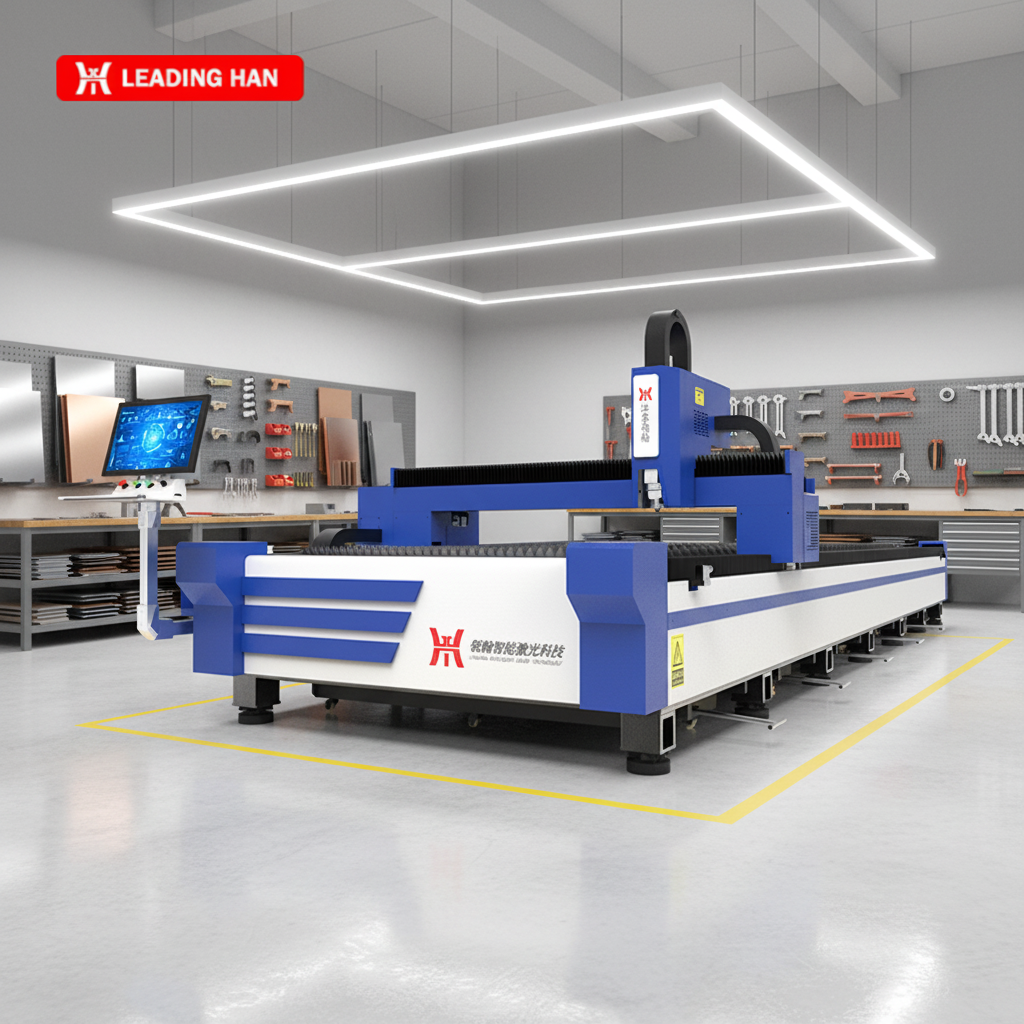
Match Fiber Laser Cutting Machine Power and Wavelength to Your Metal Types and Thicknesses
Optimal Power Ranges: 1–6 kW for 1–25 mm Mild Steel, and Why Lower Power Excels on Thin Reflective Metals
For mild steel (1–25 mm), a 1–6 kW fiber laser delivers peak efficiency: 1–2 kW units cut sheets under 6 mm cleanly at 15–20 m/min, while 6 kW handles 25 mm at 0.8 m/min. Crucially, reflective metals like copper or brass behave differently—high power increases optical damage risk from energy rebound. Instead, 500 W–1 kW systems with pulsed beams suppress reflection, enabling precise, coating-free cuts in sheets under 3 mm.
Material-Specific Challenges: Managing Copper Reflectivity, Stainless Oxidation, and Aluminum Thermal Conductivity
Material physics drive distinct process requirements:
- Copper/brass: High reflectivity demands nitrogen assist gas (≥99.5% purity) to minimize back-reflection and dross formation.
- Stainless steel: Edge oxidation necessitates high-purity nitrogen (>99.95%) shielding—raising gas costs ~30% versus oxygen-assisted mild steel.
- Aluminum: Its high thermal conductivity requires ~20% more power than mild steel for equivalent thickness; a 4 kW laser cuts 10 mm aluminum at 1.5 m/min—half the speed of stainless at the same thickness.
| Material | Critical Challenge | Mitigation Strategy | Power Adjustment vs. Mild Steel |
|---|---|---|---|
| Copper | Beam reflection | Pulsed laser + nitrogen assist | -20% power for thin sheets |
| Stainless steel | Edge oxidation | High-purity nitrogen (>99.95%) | +0% (match power) |
| Aluminum | Heat dissipation | Higher duty cycle + optimized assist gas flow | +20% power |
Fiber Laser Cutting Machine vs. CO₂: Efficiency, Cut Quality, and Total Cost of Ownership
Why Fiber Dominates Modern Metal Shops: >30% Wall-Plug Efficiency, Minimal Maintenance, and Superior Beam Delivery
Fiber lasers achieve >30% wall-plug efficiency—triple that of CO₂ systems—thanks to direct diode pumping and flexible fiber-optic beam delivery. This eliminates mirror alignment, laser gas replenishment, and associated downtime. Annual maintenance drops to under $500 for fiber lasers versus $7,000 for CO₂, driven by fewer moving parts and no consumable gases. Faster speeds—e.g., 30–40 m/min for 1 mm stainless steel versus 10–12 m/min for CO₂—cut per-part costs by 60–80%, making fiber the clear choice for high-volume production.
Edge Quality and HAZ Comparison Across Common Metals—When CO₂ Still Has Niche Advantages
Fiber lasers dominate precision cutting for metals up to 25 mm, delivering <0.1 mm HAZ and near-vertical kerfs on stainless and aluminum due to tighter focus and faster processing. CO₂ retains niche advantages where lower peak power density matters: polished edges on acrylic or wood, and smoother cuts on thick (>15 mm) non-ferrous metals like copper—its longer wavelength reduces reflectivity-related instability.
Critical Hardware and Control Features That Define a High-Performance Fiber Laser Cutting Machine
Precision CNC, Auto-Focus Z-Axis, and Capacitive Height Sensing for Consistent Kerf on Warped or Coated Sheets
Industrial-grade CNC systems maintain ±0.03 mm positioning accuracy across complex contours. Auto-focus z-axis technology dynamically adjusts focal distance within 0.1 seconds—critical when cutting coated or variable-thickness materials prone to energy scatter. Capacitive height sensors continuously monitor nozzle-to-material gaps, compensating automatically for warpage up to 15 mm. Together, these features limit kerf width variation to ≤0.05 mm—even on oiled or galvanized sheets where contact-based sensors fail.
Bed Size, Acceleration, and Nesting Efficiency: Aligning Machine Scale with Your Production Volume and Part Mix
Match bed size to your largest stock sheets: standard 4×2 m configurations accommodate 90% of industrial parts while minimizing dead zones. Gantry acceleration above 1.5 G is essential for intricate geometries; machines below 1 G waste ~18% cycle time on directional changes, per 2023 industry benchmarks. Advanced nesting software boosts material utilization by 22% over manual layouts through automatic part rotation, scrap minimization around irregular contours, and batch-specific sequencing. High-volume operations (>10,000 monthly cuts) benefit from 6×3 m beds with ≥3 G acceleration; job shops gain flexibility from compact 3×1.5 m systems with cloud-based nesting.
Optimize Cutting Performance with Assist Gas Strategy and Smart Automation Integration
Oxygen vs. Nitrogen Selection: Cost-Per-Part Analysis and Purity Requirements for Mild Steel, Stainless, and Aluminum
Assist gas selection directly shapes cut quality, edge integrity, and operational cost. Oxygen enables exothermic reactions for fast, economical cutting of mild steel up to 25 mm—but introduces oxide layers requiring secondary finishing. Nitrogen yields oxidation-free edges for stainless and aluminum but demands ≥99.95% purity to prevent contamination, raising gas costs 30–50% over oxygen. For mild steel under 6 mm, nitrogen adds $0.15–$0.25 per part versus oxygen’s $0.10–$0.15—but eliminates post-processing labor and rework. Stainless applications require ≥99.99% nitrogen purity to preserve corrosion resistance, with gas accounting for up to 40% of operational costs in high-volume runs. Aluminum’s reflectivity demands nitrogen at 15–20 bar pressure for clean kerfs—though smart gas mixers can reduce consumption by 15% via dynamic flow control.
FAQs
1. What power range is ideal for fiber laser cutting machines when working with mild steel?
For mild steel between 1–25 mm thickness, a power range of 1–6 kW is ideal. Lower power (1–2 kW) efficiently cuts thinner sheets, while higher power (up to 6 kW) is better suited for thicker materials.
2. Why is lower power recommended for cutting reflective materials like copper?
High power can cause energy rebound and optical damage when cutting reflective materials like copper. Lower-power systems (500 W–1 kW) with pulsed beams minimize reflection, making them better for precise cutting of thin sheets.
3. What role does assist gas play in fiber laser cutting?
Assist gas, such as nitrogen or oxygen, helps maintain cut quality and edge integrity. High-purity nitrogen prevents oxidation on stainless steel and aluminum, while oxygen supports economical cutting of mild steel.
4. Where does a CO₂ laser still outperform a fiber laser?
CO₂ lasers may outperform fiber lasers in scenarios requiring polished edges on materials like wood or acrylic and in cutting thicker non-ferrous metals like copper (>15 mm).
5. How does nesting software impact production efficiency?
Nesting software improves material utilization by optimizing part arrangement on the stock material, reducing scrap, and saving time in high-volume production environments.
Table of Contents
- Match Fiber Laser Cutting Machine Power and Wavelength to Your Metal Types and Thicknesses
- Fiber Laser Cutting Machine vs. CO₂: Efficiency, Cut Quality, and Total Cost of Ownership
- Critical Hardware and Control Features That Define a High-Performance Fiber Laser Cutting Machine
- Optimize Cutting Performance with Assist Gas Strategy and Smart Automation Integration
-
FAQs
- 1. What power range is ideal for fiber laser cutting machines when working with mild steel?
- 2. Why is lower power recommended for cutting reflective materials like copper?
- 3. What role does assist gas play in fiber laser cutting?
- 4. Where does a CO₂ laser still outperform a fiber laser?
- 5. How does nesting software impact production efficiency?