
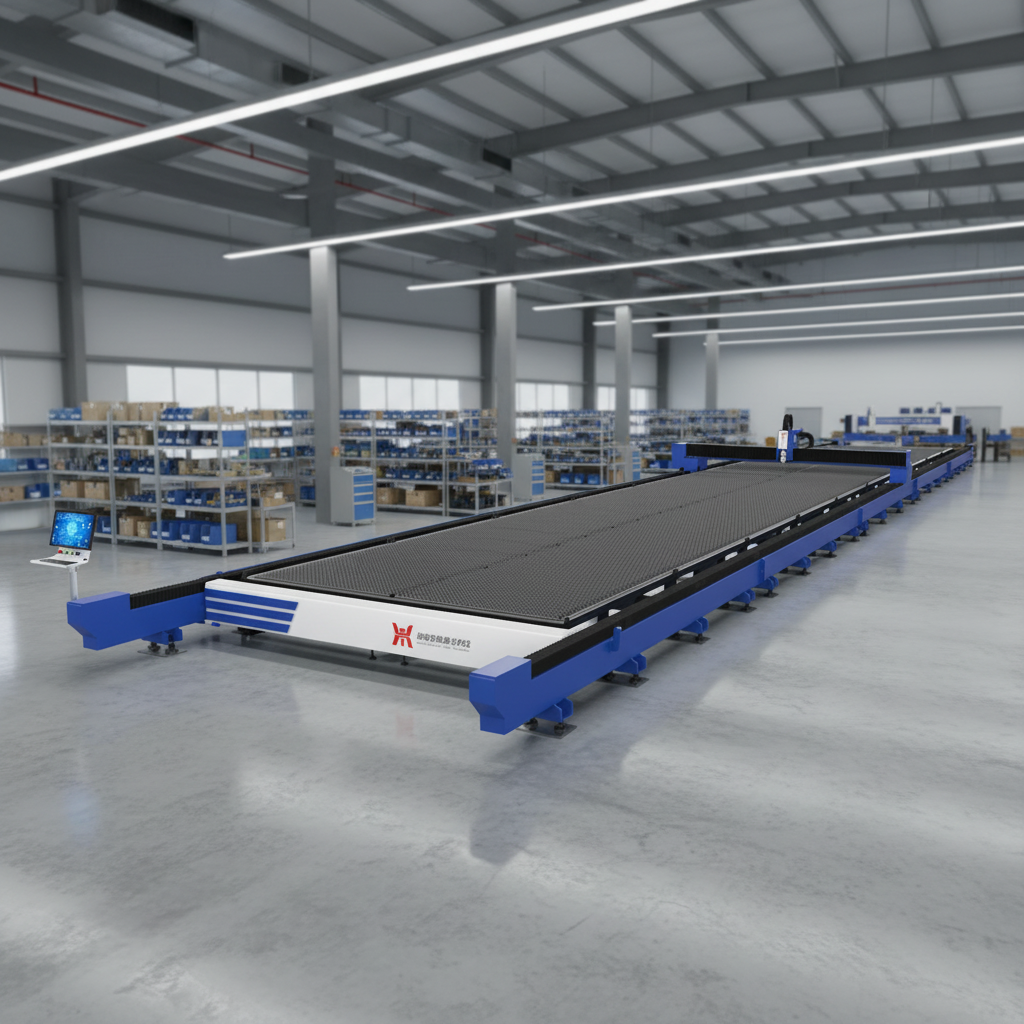
How a Laser Plate Cutting Machine Achieves Reliable 300mm Metal Cutting
Cutting metal plates up to 300mm thick demands advanced engineering that overcomes thermal diffusion, slag ejection, and beam stability challenges. Modern high-power fiber laser systems integrate precision optics, adaptive gas dynamics, and intelligent thermal management to sustain cut quality, edge integrity, and dimensional accuracy at extreme thicknesses.
High-Power Fiber Laser Physics and Beam Delivery for Extreme Thickness
Fiber lasers delivering 20–30 kW generate coherent 1070 nm light—optimally absorbed by ferrous metals—with energy conversion efficiency exceeding 95%. Specialized collimating and focusing optics minimize beam divergence, maintaining micron-level focus stability through 300mm depth. Keyhole formation traps incident radiation within the kerf, enabling deep, progressive melting. To counteract thermal lensing during prolonged operation, dynamic collimators adjust in real time, preserving focal integrity critical for consistent penetration and reduced taper.
Optimized Nozzle Design, Assist Gas Selection, and Kerf Control at 250–300mm
Conical nozzles with polished internal surfaces direct assist gas at 20–35 bar into the kerf with minimal turbulence. Nitrogen is preferred for stainless steel to prevent oxidation and ensure weld-ready edges; oxygen leverages exothermic reactions in carbon steel, boosting speed by up to 25%. At 300mm, kerf width naturally expands to 1–3 mm—controlled via closed-loop pressure modulation and standoff distance regulation (±0.1 mm). Multi-venturi nozzle designs accelerate gas flow to Mach 2, ensuring efficient molten slag ejection and minimizing dross adhesion across full thickness.
Thermal Management, Multi-Pass Sequencing, and Piercing Strategies
Layer-by-layer cutting sequences divide 300mm plates into 40–60 mm increments, with programmable cooling pauses between passes to dissipate accumulated heat and reduce warping risk by up to 40%. Piercing employs ramped power profiles—starting at 6 kW and scaling to full output over 12–15 seconds—to establish stable pilot holes without nozzle spatter or lens contamination. Water-cooled optics and pulse-modulated beam delivery further limit thermal loading, while embedded thermal sensors automatically adjust feed rate if plate surface temperature exceeds 300°C.
Material-Specific Capabilities and Limitations of the Laser Plate Cutting Machine
Carbon Steel and Stainless Steel: Cut Quality, Taper, and Speed Above 200mm
Carbon and stainless steels are the most viable candidates for laser cutting beyond 200mm due to favorable absorption and predictable thermal response. At 250–300mm, fiber lasers achieve sustained speeds of 0.6–1.2 m/min with edge roughness consistently below Ra 12.5 μm. Kerf taper remains manageable—typically 0.5°–1.2°—when paired with adaptive optics and precise standoff control. Oxygen assist improves carbon steel throughput significantly, while nitrogen preserves corrosion resistance and edge quality in stainless grades. Power demand rises steeply above 220mm, requiring 20–25 kW systems to maintain reliable keyhole stability and slag removal.
Challenges with Reflective and High-Conductivity Metals (Aluminum, Copper) Beyond 150mm
Aluminum and copper pose fundamental limitations beyond ~150mm due to high infrared reflectivity (≥80% at 1070 nm) and exceptional thermal conductivity (>200 W/m·K). These properties impede stable keyhole initiation and promote rapid heat dissipation, resulting in inconsistent melt pools and elevated spatter. Even with 30–50% higher power densities, cutting speeds drop below 0.3 m/min at 160mm, and plasma cloud interference increases by ~40%. Nitrogen or argon assist at 25–35 bar helps suppress oxidation and improve slag ejection—but edge flatness rarely meets ±1.5 mm/m tolerances required for structural applications. Copper, in particular, often requires anti-reflection coatings or hybrid laser-arc processes to achieve viable cuts beyond 120mm.
Real-World Validation: Industrial Case Studies Using the Laser Plate Cutting Machine
Offshore Fabrication: DNV-Certified 280mm DH36 Steel Cuts at 0.8 m/min
A laser plate cutting machine successfully processed 280mm DH36 marine-grade steel for semi-submersible platform braces under DNV GL certification—a stringent benchmark for offshore structural integrity. Operating at 0.8 m/min with nitrogen assist at 35 bar, the system delivered near-vertical kerfs (±0.5°), HAZ under 1.2 mm, and dimensional accuracy within ±0.8 mm/m. Proprietary nozzle geometry minimized plasma interference, eliminating post-cut milling and reducing fabrication time by 35%.
Heavy Machinery Sector: 300mm Q690D Steel Plate Cutting for Mining Equipment Frames
For mining shovel booms requiring ultra-high tensile strength and fatigue resistance, the same system cut 300mm Q690D steel at 0.9 m/min using multi-pass sequencing and adaptive power modulation (6–8 kW per pass). Taper was held below 1° across full thickness, enabling direct weld preparation without beveling. Post-cut metallurgical analysis confirmed >98% ultimate tensile strength retention in heat-affected zones—validating structural performance under dynamic loads exceeding 50 MPa.
FAQs
What metals can a laser plate cutting machine handle up to 300mm?
The machine proficiently cuts metals like carbon and stainless steel up to 300mm. However, reflective and high-conductivity metals like aluminum and copper present challenges beyond 150mm due to their properties.
How does the machine maintain cut quality in metals thicker than 200mm?
For metals over 200mm, the machine employs high-power fiber lasers, optimized nozzle design, and adaptive optics for precision. Assist gases like nitrogen and oxygen help in maintaining the quality by preventing oxidation and leveraging exothermic reactions.
Are there any real-world applications of the laser plate cutting machine?
Yes, the machine has been successfully used in the offshore fabrication and heavy machinery sectors with remarkable results, including the cutting of 280mm DH36 steel and 300mm Q690D steel for marine and mining equipment.