
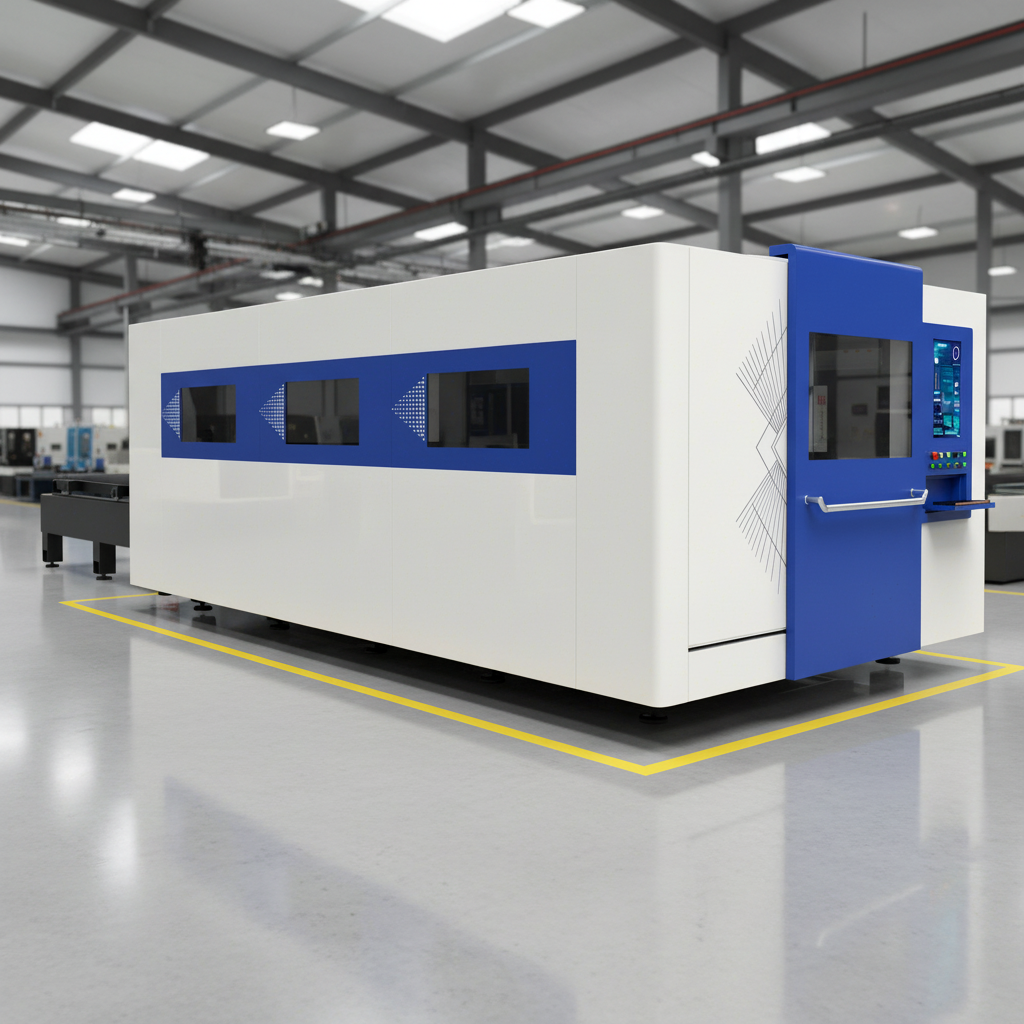
Core Technical Drivers of 10× Speed Gains in Sheet Metal Laser Cutting Machines
Fiber Laser Source Advantages: Wavelength Efficiency, Beam Quality, and Power Density
Modern fiber lasers drive transformative speed gains through three interdependent attributes. Their 1,070 nm wavelength achieves ~30% greater absorption in metals than CO₂ lasers—concentrating energy more efficiently at the cut zone. Near-perfect beam quality (M² <1.1) enables sub-20-micron focus spots, generating power densities exceeding 10⁸ W/cm². This intensity enables rapid material vaporization: a 15 kW fiber laser cuts 10 mm stainless steel at 12 m/min with nitrogen assist—six times faster than a 6 kW system (SME 2022). Coupled with wall-plug efficiency above 40%, fiber lasers sustain peak output during prolonged operation with minimal thermal drift.
Optimized Beam Delivery & Motion Control: Acceleration, Precision, and Reduced Non-Cutting Time
Raw laser power delivers little without equally advanced motion systems. High-torque linear motors and lightweight carbon fiber gantries achieve accelerations beyond 3G—enabling sharp directional changes without vibration or settling delay. This is especially critical for intricate contours, where cutting speeds often fall below 20% of maximum. Integrated motion controllers synchronize axis trajectories with real-time laser modulation, eliminating overburn at corners. Paired with capacitive height sensing, these systems reduce non-cutting time by up to 40%, a decisive advantage for thin-sheet production where acceleration—not laser power—is the primary throughput limiter.
Automation Integration: Turning Raw Speed into Real Throughput for Sheet Metal Laser Cutting Machines
Advanced automation converts theoretical laser performance into measurable production gains by eliminating manual bottlenecks. Robotic loading/unloading systems and AI-driven nesting software work in concert to maximize machine utilization.
Auto-Loading/Unloading Systems and Intelligent Nesting Software Cut Idle Time by Up to 65%
Robotic arms enable continuous sheet feeding and part removal—supporting true lights-out operation. Simultaneously, intelligent nesting software optimizes part placement across raw sheets, reducing scrap by up to 18% while compressing job setup time. Together, these systems cut machine idle periods by as much as 65% (Fabricating & Metalworking 2023), directly converting high-speed cutting capability into sustained throughput.
Real-Time Adaptive Control for Mixed-Thickness Runs Without Manual Intervention
Modern CNC controllers dynamically adjust laser power, focal position, and assist gas pressure upon detecting thickness variations—eliminating manual recalibration between jobs. Changeover time drops from hours to minutes: switching seamlessly between 1 mm and 12 mm stainless steel within a single production cycle preserves peak cutting velocity across diverse batches.
Speed vs. Competing Methods: Why Sheet Metal Laser Cutting Machines Outperform Plasma, Waterjet, and Punching
Sheet metal laser cutting machines deliver 3–10× higher processing speeds than plasma, waterjet, or mechanical punching—without compromising precision or flexibility. Unlike plasma, which produces wide kerfs (>3 mm) and heat-affected zones that distort thin materials, lasers achieve clean, narrow cuts under 0.2 mm even at full speed. Waterjet systems operate ~70% slower on metals under 20 mm and incur significantly higher operational costs—up to 45% more due to abrasive consumption and pump maintenance. Punch presses demand custom tooling, lengthy setups, and lack geometric versatility, making them inefficient for low-volume or complex parts. By contrast, laser’s non-contact process eliminates mechanical stress, reduces material waste by 15–30% through optimized nesting, and maintains consistent quality across mixed-thickness runs—no retooling required.
Maximizing Actual Cutting Speed: Key Operational Factors for Sheet Metal Laser Cutting Machines
Laser Power, Material Thickness, and Assist Gas Selection—Quantified Impact on Linear Speed
Achievable cutting speed depends critically on the interplay of laser power, material thickness, and assist gas. A 6 kW laser cuts 10 mm mild steel at ~4 m/min—2.5× faster than a 3 kW system (~1.5 m/min). Thickness has an inverse logarithmic relationship with speed: doubling material thickness typically halves linear velocity to preserve edge quality and dross control. Assist gas introduces key trade-offs—oxygen leverages exothermic reactions to boost carbon steel speed by ~20%, but introduces oxidation; nitrogen yields oxide-free stainless steel edges at lower velocities due to stricter purity and pressure requirements. Optimal throughput emerges only when all three variables are tuned together—not in isolation.
Surface Finish and Edge Quality Trade-offs at High-Speed Settings
Pushing sheet metal laser cutting machines to maximum rated speeds inevitably affects edge integrity—particularly beyond 8 mm thickness. Excessive velocity shortens beam dwell time, increasing dross formation by up to 40% and yielding rougher surfaces. Stainless steel cut at 20 m/min often requires secondary grinding to remove micro-burrs; mild steel processed above 15 m/min may exhibit visible heat distortion. To balance productivity and quality, reserve peak speeds for internal, non-visible features—and reduce velocity by 15–25% for functional or aesthetic edges. Consistent nozzle maintenance and focal point calibration further mitigate degradation during high-throughput operation.
FAQ
What are the advantages of using fiber laser for sheet metal cutting?
Fiber lasers use a wavelength that offers about 30% greater absorption in metals than CO₂ lasers, leading to more efficient energy concentration at the cut zone. This, along with high beam quality and power density, allows for rapid and precise cutting.
How do automated systems improve the throughput of laser cutting machines?
Automated systems like robotic loading/unloading and AI-driven nesting software maximize machine utilization by eliminating manual bottlenecks, leading to a significant reduction in idle time and increased sustained throughput.
Why are laser cutting machines faster than other methods like plasma or waterjet?
Laser cutting machines offer 3–10× higher processing speeds and cleaner cuts, without the mechanical stress or high operational costs associated with plasma and waterjet systems.
What factors influence the actual cutting speed of laser cutting machines?
The cutting speed is influenced by laser power, material thickness, and assist gas choice. Each of these factors must be optimized together to achieve the best throughput.
Table of Contents
- Core Technical Drivers of 10× Speed Gains in Sheet Metal Laser Cutting Machines
- Automation Integration: Turning Raw Speed into Real Throughput for Sheet Metal Laser Cutting Machines
- Speed vs. Competing Methods: Why Sheet Metal Laser Cutting Machines Outperform Plasma, Waterjet, and Punching
- Maximizing Actual Cutting Speed: Key Operational Factors for Sheet Metal Laser Cutting Machines
-
FAQ
- What are the advantages of using fiber laser for sheet metal cutting?
- How do automated systems improve the throughput of laser cutting machines?
- Why are laser cutting machines faster than other methods like plasma or waterjet?
- What factors influence the actual cutting speed of laser cutting machines?