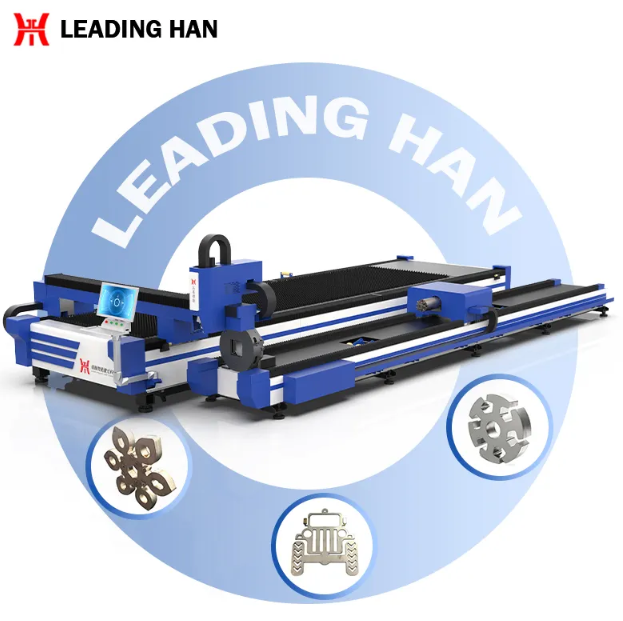
Precision Cutting Across Complex Tube Geometries
Micron-Level Accuracy on Round, Square, and Oval Profiles
Fiber laser tube cutting machines achieve ±0.254 mm positional accuracy across round, square, oval, and custom extruded profiles—eliminating the need for secondary machining in structural frameworks, medical devices, and precision assemblies. Independent testing confirms 99.7% repeatability in multi-axis contour cutting, outperforming conventional sawing by 50% in dimensional consistency.
How Beam Quality (M² < 1.1), Dynamic Focusing, and Collision Avoidance Ensure Consistency
Three integrated technologies maintain geometric fidelity across complex shapes:
- Beam quality (M² < 1.1) ensures minimal focal spot distortion, enabling kerf widths under 0.1 mm
- Dynamic focusing continuously adjusts the focal point during contour traversal to prevent edge taper on curved or asymmetrical profiles like L-angles and teardrop tubes
-
Collision avoidance uses real-time 3D mapping sensors to halt motion when deviations exceed 0.5 mm, protecting both tooling and workpiece
Together, these features reduce geometric errors by 32% compared to legacy systems—especially critical when cutting non-uniform cross-sections.
Superior Edge Quality Eliminating Secondary Processing
Fiber laser tube cutting delivers edge quality that bypasses traditional post-processing entirely—reducing labor, time, and cost without compromising performance.
Smooth, Oxide-Free Cuts with Ra < 3.2 μm Enabling Direct Welding or Powder Coating
Laser cutting using inert gas shielding creates surfaces so smooth they measure under 3 microns Ra roughness, which is comparable to what fine grinding achieves. Best of all, there's no oxidation issues, no pesky dross buildup, and absolutely no thermal discoloration either. What does this mean for manufacturers? Parts coming off these machines can go straight into welding stations, brazing setups, or even powder coating systems without needing any extra prep work. Fabrication shops across the country have seen real benefits from this technology too. Some top shops claim workers save around 15 minutes per piece on those tedious deburring tasks and cleaning jobs. That adds up fast when multiplied across hundreds of parts daily, making production lines faster while cutting down on how much hands-on labor is required overall.
Minimal Heat-Affected Zone (< 0.1 mm) Preserves Material Strength and Integrity
With tight beam control, the heat affected area stays below 0.1 mm, making it about five times smaller compared to what we see with plasma methods. This really helps maintain the structural properties in important parts where stress matters most, like threaded sections, those mounting flanges, and areas prone to fatigue from bending forces. When tested for tension, these materials show only around 2% difference from their original strength levels and hardness characteristics. That kind of consistency makes all the difference for things used in aircraft construction, buildings made with steel structures, and components subjected to high pressure within hydraulic systems.
Broad Material and Profile Versatility Without Hardware Changes
Seamless Processing of Stainless Steel (up to 12 mm), Aluminum (up to 8 mm), Copper, and Brass
Today's fiber laser tube cutters handle a wide range of metals including stainless steel from 0.5 to 12 mm thick, aluminum alloys between 0.8 and 8 mm, plus copper and brass as well. All this gets done through just one cutting head that doesn't need any nozzles. The system has adaptive optics that adjust on their own when dealing with different material reflectivities. At the same time, there's real time monitoring happening behind the scenes which keeps changing where the focus is and how much assist gas pressure is needed whenever switching between different alloys. No need to mess around with mechanical parts anymore, so changing from one job to another takes less than 90 seconds now. According to Fabrication Technology Studies back in 2023, shops using these machines can get up to 98% material usage even when working with batches containing various profiles and multiple types of alloys. And best part? They don't have to compromise on cut quality or keep swapping out hardware components.
Key Capabilities:
- Multi-metal processing: Reflectivity-agnostic optics handle copper, brass, aluminum, and carbon/stainless steels
- Thickness range: 0.5–12 mm stainless; 0.8–8 mm aluminum
- Profile adaptation: Auto-recognition of over 20 standard geometries—including round, rectangular, oval, and custom extrusions
Significant Productivity and Cost Advantages
3–5× Faster Cycle Times vs. CNC Sawing and 70% Reduced Setup Time per Batch
When it comes to cutting tubes, fiber lasers can cut through materials anywhere from three to five times quicker than traditional CNC saws. Why? Because there's no need for constant tool switching, waiting during indexing, or dealing with parts wearing out over time. The setup process is dramatically shortened too - around 70% less time per production run when workers simply upload their CAD designs rather than spending hours adjusting blades, clamps, and all those metal fixtures that always seem to need recalibration. What does this mean for businesses? Labor expenses drop by about 20%, factories see roughly 15% more output each year, and companies waste significantly less material - sometimes as much as 30% less scrap going into landfills. Plus, these machines consume about 15% less power compared to plasma alternatives, and they almost completely eliminate the need for extra finishing work that typically follows other cutting methods. For manufacturers looking at long term savings, fiber lasers aren't just about faster production speeds. They represent real money saving opportunities across the entire operation.
FAQ Section
What is the advantage of fiber laser cutting over traditional methods?
Fiber laser cutting offers higher accuracy, faster cycle times, and reduced setup time compared to traditional CNC sawing. It also significantly decreases material waste and labor costs.
Can fiber laser cutting machines handle different metal profiles without hardware adjustments?
Yes, modern fiber laser cutting machines can seamlessly process a variety of metals and profiles without the need for hardware changes, thanks to adaptive optics and real-time monitoring systems.
How does fiber laser cutting maintain material strength?
Fiber laser cutting maintains material strength by minimizing the heat-affected zone, preserving the structural integrity and original strength levels of the materials.