
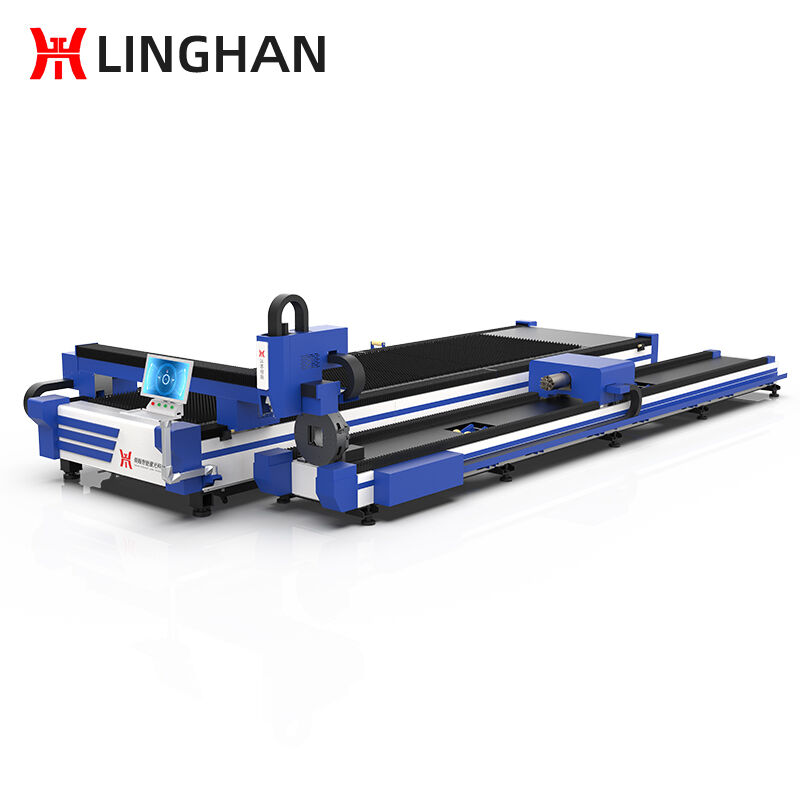
Dual-Function Design: Seamless Cutting of Tubes and Plates
Versatility of the Tube and Plate Laser Cutting Machine in Modern Metal Fabrication
The latest generation of tube and plate laser cutters has changed how manufacturing facilities operate by merging what used to be two different machines into one unit. These advanced systems work on carbon steel and stainless steel materials that range anywhere between half a millimeter and 25 millimeters thick, achieving an impressive accuracy level of plus or minus 0.1 mm according to research published by Material Processing Institute back in 2023. What makes these machines particularly valuable is their ability to tackle both flat sheet metal and round tubing during the same production run. For factory managers concerned about workshop space, this means they can cut down on required floor area by roughly 40 percent when compared to older methods that needed multiple dedicated machines for each task.
Precision Cutting of Complex Tube Profiles With Minimal Distortion
Fiber laser technology achieves distortion-free cuts on square, round, and rectangular tubing through dynamic focal length adjustment. Advanced machines integrate rotary axes and specialized clamps that maintain ±0.05° angular precision during high-speed rotation, enabling clean 45° miter cuts on 150 mm diameter pipes (Industrial Laser Applications Review 2023).
Efficient Transition Between Flat Sheets and Structural Tubing
Modern systems feature dual cutting tables for parallel processing of plates and tubes, smart material recognition that auto-adjusts power settings between 1 kW (thin sheets) and 12 kW (thick-wall tubing), and a unified software interface that reduces programming time by 65%.
Case Study: 40% Faster Job Changeover by Eliminating Equipment Swaps
A Midwest automotive supplier reduced changeover time from 47 minutes to 28 minutes after implementing a dual-function system, achieving 92% operational uptime (Machinery Efficiency Report 2023). The integrated design eliminated manual recalibration between jobs, separate tooling inventories, and cross-department equipment scheduling conflicts.
Fiber Laser Technology: Powering High-Speed, High-Quality Cuts
High-wattage fiber lasers for efficient cutting of thick metal sections
Modern tube and plate laser cutting machines utilize 6kW+ fiber lasers to process steel plates up to 1.5" thick at speeds exceeding 600 IPM. Industry benchmarks show these systems achieve 5x faster cutting speeds than CO2 lasers when handling 3/4" carbon steel, allowing manufacturers to complete heavy-duty jobs 62% faster.
Energy-efficient operation reducing power consumption and costs
Fiber laser technology consumes up to 50% less energy than traditional methods while maintaining peak performance. Studies reveal energy savings of $0.38 per cutting hour translate to annual reductions of $9,120 for operations running two shifts daily—making it a key advantage in high-volume production.
Superior beam quality for narrower kerf widths and cleaner edges
With beam quality parameters (M²) below 1.3, contemporary fiber lasers produce kerf widths as narrow as 0.004", eliminating secondary deburring operations. This enables ±0.001" tolerances on stainless steel sheets and maintains surface roughness below 125 µin, streamlining post-processing workflows.
Smart Automation and Robotics Integration
Automated Loading and Unloading for Continuous 24/7 Production
Tube and plate laser cutters these days keep running non-stop thanks to robotic arms working alongside conveyor belts for automated material movement. The machines come with built-in pallet changers so workers can actually load new flat sheets or already cut tubes while the system is still working on something else. This cuts down waiting periods dramatically, maybe as much as 90% in some cases according to what we've seen in practice. Big manufacturers really benefit from this setup because they no longer need people constantly involved in those boring repeat jobs where someone has to position those long 20 foot stainless steel tubes just right. And that means production scales up nicely without needing extra staff around the clock.
Balancing ROI: High Initial Cost vs. Long-Term Labor and Time Savings
Robotic systems do cost around 30 to 50 percent more initially compared to traditional setups, but most manufacturers find they get their money back within about 12 to 18 months. The savings come from roughly 60 to 75 percent less money spent on labor, about half as many mistakes needing correction, and jobs switching between different materials can happen almost twice as fast. According to recent industry data from metal fabricators in 2024, nearly eight out of ten companies that implemented robots saw complete return on investment within just two years after cutting down on night shift operations and reducing machine downtime. Companies that take a gradual approach to automation while investing in training programs for existing staff tend to see the best long term improvements in productivity without losing valuable human expertise along the way.
Advanced Software for Nesting, Programming, and Process Optimization
Modern tube and plate laser cutting machines rely on intelligent software solutions to maximize operational efficiency. These systems bridge the gap between design complexity and production scalability through two key innovations.
AI-Driven Nesting Algorithms Maximizing Material Utilization
Modern nesting software now uses machine learning techniques to examine different part shapes and figure out the best way to arrange them on sheets. This kind of smart technology helps manufacturers get around 80% material usage in their factories. Traditional hand-planning just can't compete with what these AI systems do automatically. They constantly tweak the layout patterns for those tricky irregular tubes and plates of all sizes. According to recent industry research from 2024, this approach cuts down waste by somewhere between 18 and 22 percent. That makes a huge difference especially when working with expensive metals such as stainless steel or that special aluminum used in aircraft manufacturing where every bit saved counts toward better profits.
| Nesting Method | Material Waste | Setup Time |
|---|---|---|
| Manual Layout | 25-30% | 45 minutes |
| AI-Optimized | 8-12% | <10 minutes |
Real-Time CNC Programming Adjustments for Dynamic Order Demands
Integrated software platforms enable immediate parameter changes across tube and plate cutting operations. When order priorities shift, the system automatically recalculates feed rates, laser power settings, and collision-avoidance paths. This responsiveness slashes reprogramming time by 65% compared to traditional workflows, allowing urgent requests to be accommodated without disrupting active cycles.
These advancements empower fabricators to handle mixed-order batches with pharmaceutical-grade precision while maintaining throughput speeds exceeding 90 meters per minute on structural tubing.
Measurable Gains in Productivity and Cost Efficiency
Modern manufacturers leveraging tube and plate laser cutting machines achieve quantifiable efficiency gains through three key performance indicators. By aligning advanced automation with precision engineering, these systems deliver measurable improvements across production metrics.
OEE Improvements: Quantifying Uptime and Output Gains
Tube laser systems elevate Overall Equipment Effectiveness (OEE) by maintaining 85–92% uptime through automated material handling and collision-free cutting paths. A 2023 analysis of industrial productivity metrics revealed facilities using dual-function laser cutters reduced nonproductive time by 40% compared to traditional methods.
Reduced Material Waste and Faster Throughput Boosting ROI
AI-driven nesting algorithms optimize material usage, achieving 95% plate utilization for complex geometries. This precision reduces raw material costs by 18–22% annually while sustaining cutting speeds of 70 meters/minute for 6mm stainless steel. Combined with 24/7 robotic operation, throughput increases 25–35% without additional labor.
Data Point: Automotive Suppliers Report 35% Increase in Production Output
Early adopters in automotive manufacturing demonstrate the technology's scalability—one Tier-1 supplier reduced production floor space by 30% while producing 1,200 precision-cut components per hour. Automated quality systems contributed to a 52% reduction in post-processing labor through first-pass accuracy rates exceeding 99.3%.
FAQ Section
What types of materials can the tube and plate laser cutting machine handle?
The machine is capable of working with carbon steel and stainless steel materials ranging between half a millimeter and 25 millimeters thick.
How do fiber lasers benefit the cutting process?
Fiber lasers achieve high-speed, high-quality cuts, consuming less energy than traditional methods and offering superior beam quality, resulting in cleaner edges and narrower kerf widths.
What improvements can manufacturers expect from using dual-function cutting systems?
Manufacturers enjoy benefits like faster job changeover times, reduced material waste, higher throughput, and increased overall equipment effectiveness (OEE).
Table of Contents
- Dual-Function Design: Seamless Cutting of Tubes and Plates
- Fiber Laser Technology: Powering High-Speed, High-Quality Cuts
- Smart Automation and Robotics Integration
- Automated Loading and Unloading for Continuous 24/7 Production
- Balancing ROI: High Initial Cost vs. Long-Term Labor and Time Savings
- Advanced Software for Nesting, Programming, and Process Optimization
- Measurable Gains in Productivity and Cost Efficiency
- FAQ Section