
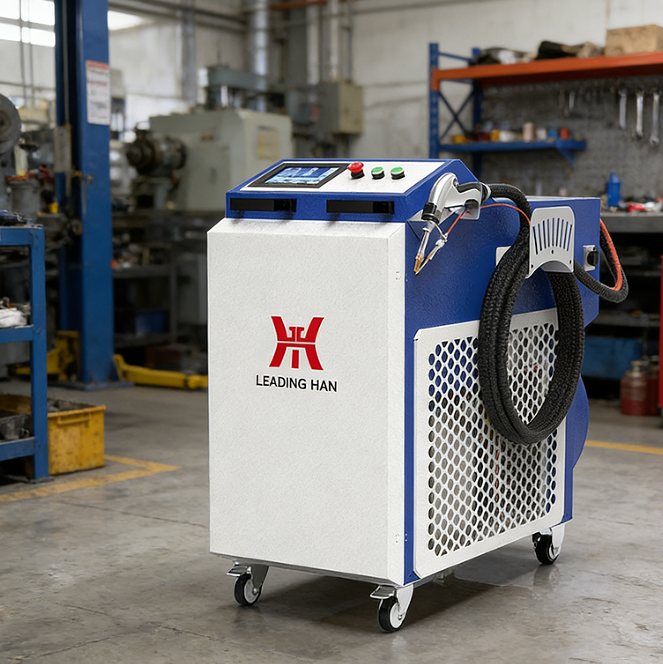
Enabling Precision Welding in Confined and Hard-to-Reach Spaces
Ergonomic handheld design and compact beam delivery for tight-geometry welding
Portable laser welding tools come with a comfortable, handheld shape that helps workers avoid getting tired after hours of use in tight spaces. The whole unit is light enough to carry around easily, and weighs just right so operators can move it around obstacles without much effort, which matters a lot when dealing with delicate parts or working inside confined areas. These machines have really compact laser heads that can focus the beam down to almost half a millimeter accuracy, something that makes them great for detailed jobs such as connecting thin metal sheets in electronic gadgets, car parts, or even tiny housing units for medical devices. Since they generate very little heat, there's no risk of materials warping or getting damaged, so nobody has to spend extra time fixing things after welding. Field technicians get consistent quality welds without dragging heavy machinery from one spot to another, and many shops report cutting down on waiting periods by about half during regular maintenance work throughout factories, construction sites, and repair centers.
Real-world application: HVAC duct repair in high-rise building maintenance
Most HVAC duct repairs in tall buildings happen in tight spots like vertical shafts, ceiling spaces, or cramped mechanical rooms where there's barely 30 cm of space to work. Portable laser welding equipment lets technicians fix leaks or strengthen joints right there on site, so they don't have to tear apart whole sections of ductwork. This saves tenants from weeks of noise and mess during traditional repairs which often meant shutting down systems completely. When working on aluminum ducts specifically, the laser produces clean welds that go all the way through without messing up nearby fireproof insulation or damaging control wires. Real world tests across several skyscraper renovations indicate repair times drop by around 30 to 40 percent compared to old arc welding methods, and still meet those strict ASHRAE standards for airflow and indoor air quality. What makes this technology stand out is how portable it is combined with its pinpoint accuracy and minimal heat damage. These features mean plumbers can get durable, code approved fixes done even in the tightest spaces, keeping buildings running smoothly while cutting down on expensive labor hours in facilities where every minute matters.
Accelerating On-Site Repairs Across High-Stakes Industries
Portable laser welding machines transform field maintenance by enabling complex, structural repairs without equipment disassembly or facility transport—a capability that directly mitigates six-figure hourly downtime losses in aerospace, automotive, and energy sectors.
Automotive field repairs: Aluminum crash component re-welding without disassembly
Today's collision repair techs are able to do structural welds that meet OEM standards on those cars packed with aluminum parts, all thanks to these handheld laser systems. They can reach into tricky spots like wheel arches, A-pillars, and suspension mounting points without having to take apart whole panels or subframes first. What makes this work so well is how the laser controls its heat input so precisely. This helps prevent warping in those thin aluminum sheets that are usually between 1 and 2.5 mm thick. The result? Joint efficiencies hitting around 90% while still passing both SAE J2340 tests and whatever safety requirements the car manufacturers set. Shops that have gotten certified for this method report cutting down repair times by about two thirds when compared to old school MIG or TIG welding techniques. And best of all, there's no drop off in how strong the repaired areas are or their ability to resist rust over time.
Aerospace MRO: FAA-compliant in-situ titanium landing gear bracket repair
Portable fiber lasers can fix critical titanium parts on planes according to FAA rules (AC 20-187) without taking the whole aircraft out of commission or tearing apart hangars. The engineers monitor temperatures as they work so they can keep things hot enough but not too hot. This helps prevent those nasty cracks that happen in Ti-6Al-4V when welding thin brackets down to 1.2mm thickness. All these repair methods have been officially certified under AS9100D standards for quality control. What this means is no waiting around for three weeks while parts get sent somewhere else for fixing. Mechanics can actually do the job right where the problem exists, whether that's sitting on the runway or deep inside some remote maintenance facility. Aircraft stay operational longer because of this approach, and everyone gets peace of mind knowing the welds hold up thanks to detailed records and proper non-destructive testing after completion.
Supporting Diverse Materials and Critical Manufacturing Applications
Dissimilar metal welding: Copper-to-stainless steel joints in medical devices and electronics
Good thermal control makes portable laser welding work for joining different metals like copper and stainless steel without creating those pesky intermetallic phases or brittle fractures that ruin things. Medical device makers really need this capability since their ISO 13485 certified tools require completely sealed connections between conductive copper parts and stainless steel casings that resist corrosion. The technique gets penetration depths around 0.8 mm while keeping distortion below 0.1 mm, which means it works great for tiny welds on pacemaker components, hinge points in endoscopes, and MRI compatible surgical instruments. When looking at electronics applications, these welds maintain electrical connections across copper-stainless interfaces without the problems of thermal cycling failures we see in battery terminals and RF connectors operating at high frequencies. According to AWS studies, laser welded joints between different metals hold about 92% of the original metal strength, beating traditional resistance welding or brazing techniques by roughly 34% as noted in the AWS D17.1 standard from 2023.
Powering Mobile Infrastructure Welding with Rapid Deployment
Laser welding machines that can be moved around are changing how fast we can respond when infrastructure breaks down. These portable units produce welds as good as those made in workshops, but they work anywhere from bridge construction sites and pipeline corridors to dangerous offshore installations and areas hit by disasters. They come with compact power packs, batteries for backup power, and rugged enclosures rated IP54 so they function even where there's no generator power, no shielding gas available, or cranes just aren't practical. No need to wait for equipment to warm up means workers get going immediately. The adjustable laser beams create solid welds through steel plates up to 12mm thick regardless of weather conditions or extreme temperatures. Real world tests indicate these mobile systems slash repair times by about 30 to 50 percent compared to bringing parts back to a shop for welding. That speed makes all the difference during emergencies without compromising safety standards like ASME Section IX or AWS D1.1 requirements. What really matters is that these machines transform what were once temporary worksites into full blown fabrication centers right on location. This cuts down on transportation costs, keeps projects moving forward smoothly between phases, and builds stronger defenses against unexpected events while managing assets effectively over time.