
Power Performance and Thermal Efficiency in Thick-Section Welding
Penetration depth and weld integrity on 8–25 mm carbon steel at 3–6 kW output
The amount of laser power determines how deep the weld goes when working with thicker materials. When dealing with carbon steel between 8 and 12 mm thick, around 3 kW will get full penetration with less than 0.3 mm variation at the bottom, which matters a lot for things like pressure vessels where structural integrity counts. Going up to 6 kW makes it possible to weld through 20 to 25 mm sections in one pass while still getting tensile strength close to 98% of what's found in the original material according to AWS standards from 2020. What sets lasers apart is their ability to focus so much energy in such a small area, shrinking the Heat Affected Zone down to about 0.8 to 1.2 mm wide. That's actually less than half what we typically see with traditional arc welding methods, meaning there's less chance of grain growth problems, warping issues, and fewer times we need to machine away excess after welding. Looking at high speed footage shows that keyholes form consistently stable between 4 and 6 kW settings, resulting in porosity levels staying under 0.2% throughout regular production batches.
Duty cycle stability under continuous heavy-industry loads vs. conventional MIG/TIG
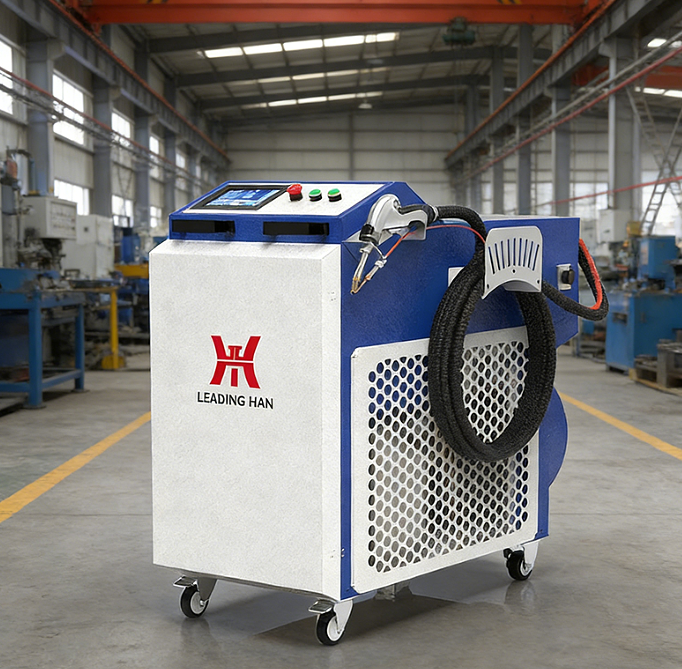
What makes industrial lasers stand out is their ability to handle heat over long periods. Take the 4in 1 laser welding machine for example it can run at 95% efficiency throughout those grueling 10 hour shifts on offshore platforms, which is actually three times better than what most MIG welders manage. The secret? A built in water cooling system keeps nozzle temps under 40 degrees Celsius even when pushing 6 kW continuously. Air cooled TIG torches just cant compete they need those annoying 15 minute breaks every single hour. Steel fabricators who switched to this system see about half as many thermal shutdown issues compared to traditional arc welding methods. Another big plus no electrodes wearing down or contacts getting damaged means consistent penetration quality all day long through those 8 hour work stretches. According to the latest ISO standards from 2023, this kind of reliable operation cuts energy usage by around 18 kilowatt hours each shift. For companies running multiple shifts daily, that adds up to roughly seven hundred forty thousand dollars saved annually in electricity costs alone.
Real-World Heavy Industry Applications of the 4in 1 Laser Welding Machine
Offshore platform fabrication: Cycle time reduction and defect rate improvement (Aker BP case study, 2023)
When Aker BP rolled out their new 4in 1 laser welding setup back in 2023, they saw real improvements working on those crucial pipeline connections made from 18 mm carbon steel. The numbers tell quite a story actually: compared to old fashioned submerged arc welding methods, the whole process took 40% less time to complete. And guess what? Defects went down by around 32%. Why? Because this laser tech gives much more consistent penetration depth every single time and creates way less annoying spatter during operation. For companies operating underwater where time is literally money, these kinds of enhancements make all the difference. No more waiting for repairs means no costly delays either. We're talking about saving roughly $1.2 million worth of potential fines just per individual platform when things get delayed.
Automotive chassis production: Handheld 4in 1 laser welding machine vs. robotic systems in throughput and flexibility
Handheld 4in 1 laser welding machines are increasingly adopted in automotive chassis assembly where robotic cells struggle with complex geometries. Unlike fixed automation requiring part repositioning or disassembly, the handheld unit enables direct access to confined joints in SUV frames. A 2024 benchmark study found:
- 27% faster throughput on irregular joints
- 19% lower spatter than pulsed MIG
- Seamless transitions between aluminum cross-members (6 mm) and steel brackets (10 mm) within the same workstation
This portability cuts idle time by 15% versus robotic reprogramming-making it especially effective for low-volume, high-mix production without sacrificing weld quality.
Material-Specific Efficiency Across Heavy-Duty Alloys
Weld quality benchmarks-spatter rate, HAZ width, and tensile retention-for carbon steel, stainless steel, and cast iron (4–12 mm)
Weld quality varies significantly across alloys-and the 4in 1 laser welding machine delivers differentiated advantages for each. In carbon steel (4–12 mm), spatter remains ≤5%, outperforming standard MIG by 40%. HAZ averages just 1.2 mm-nearly half the width of arc-welded equivalents-preserving microstructure and dimensional stability. Tensile strength retention exceeds 95%.
Stainless steel benefits more markedly: spatter drops below 3%, HAZ narrows to 0.9 mm in 10 mm austenitic grades, and phase retention at the joint interface exceeds 98%-a key factor in maintaining corrosion resistance.
Cast iron presents greater thermal challenges, but modulated laser pulses combined with controlled preheat reduce cracking risk. Spatter stays under 7% in 12 mm sections, and tensile retention improves to >92%-a substantial gain over the 75–85% typical of conventional methods.
| Material | Spatter Rate | HAZ Width | Tensile Retention |
|---|---|---|---|
| Carbon Steel | ≤5% | 1.2mm avg | >95% |
| Stainless Steel | <3% | 0.9mm avg | >98% |
| Cast Iron | <7% | 1.4mm avg | >92% |
These results reflect how adaptive parameter control compensates for differences in thermal conductivity, reflectivity, and solidification behavior-enabling consistent, high-integrity welds across diverse industrial materials.
Strategic Selection Criteria for Industrial Deployment of the 4in 1 Laser Welding Machine
When choosing a 4-in-1 laser welding machine for serious industrial work, there are several key factors worth considering beyond just looking at specs sheets. Material compatibility should come first check if the manufacturer has tested results on important metals like carbon steel up to 25mm thick and various stainless steel grades, especially how well it handles heat affected zones below 0.8mm wide. Power matters too machines rated between 3 to 6 kilowatts need stable thermal performance. For factories running non-stop shifts eight hours straight, look for equipment that can handle at least 90% duty cycles without breaking down something basic models just cant manage. Automation capabilities make a big difference integrated PLC systems cut down on manual adjustments by around two thirds compared to simple handheld units according to industry standards. Dont forget about long term costs either. While initial price tags grab attention, real savings come from lower energy consumption often 30% better than traditional arc welding methods, plus easier maintenance schedules and options for future upgrades. And finally, think about how everything fits together space limitations, air flow needs, and whether staff will need special training all affect how quickly the machine gets installed and starts generating returns. Matching these considerations with specific production goals and workplace safety rules leads to stronger, more adaptable installations in busy manufacturing settings.