
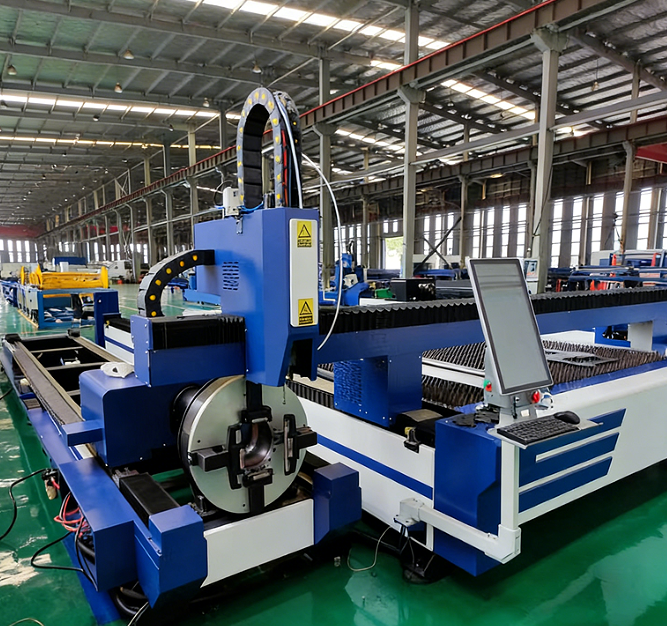
Unmatched Precision Across Tubes and Plates
Tube and plate laser cutting machines deliver sub-millimeter accuracy across complex 2D and 3D geometries—enabling intricate designs previously unachievable with conventional methods. Advanced optical systems maintain beam focus within 0.1 mm across curved surfaces and variable wall thicknesses, ensuring dimensional fidelity regardless of part geometry.
Superior Edge Quality Reducing Post-Processing by Up to 70%
Laser cutting creates edges that are almost polished already, with very little leftover residue or distortion from heat affecting surrounding areas. Most shops find they don't need to spend extra time on grinding or removing burrs after laser work. According to some recent industry reports, this cuts down on secondary finishing tasks by about two thirds overall (Fabrication Technology Review mentioned this in their 2025 edition). The thin cut made by lasers keeps the material strong and intact throughout the process, which means less thermal stress builds up. This matters a lot when making parts that require tight tolerances and structural reliability, especially in aerospace or medical device manufacturing where precision is absolutely essential.
CNC-Controlled Repeatability Within ±0.05 mm Tolerance
Computer Numerical Control (CNC) systems ensure consistent precision across production runs. Precision-engineered motion components maintain positional accuracy below ±0.05 mm—even after thousands of cycles. This repeatability directly supports part interchangeability in tight-tolerance assemblies and reduces scrap rates by eliminating dimensional drift between batches.
Broad Material and Geometry Versatility
Consistent Performance on Steel, Stainless Steel, Aluminum, and Copper
Tube and plate laser cutting machines produce really good cuts on all sorts of metals, from super thin copper sheets at 0.5 mm right up to thick carbon steel plates measuring 25 mm, and there's no need to switch out any parts during operation. The speed stays pretty much the same regardless of what material is being worked on. Take stainless steel that's 3 mm thick for instance, cutting it at around 12 meters per minute still gives clean edges without issues. These machines have something called adaptive optics that tweak where the laser focuses its power when dealing with tricky materials such as aluminum which reflects light or conducts heat so well. This helps avoid problems like damage from reflected beams or warping caused by excessive heat buildup. When looking at how they stack up against plasma cutting systems, these lasers cut down on waste significantly too, somewhere between 18% to 22% less scrap according to Fabrication Tech Review from last year.
Multi-Process Capability: Beveling, Notching, Slotting, and Hole Marking in One Setup
The systems bring together several secondary operations like ±45° beveling, precise notching work, slot creation, and marking holes all within one clamping cycle. When there's no need to reposition parts during processing, it keeps everything aligned properly across different features. This alignment makes possible those tight fitting interlocking parts where tolerances stay within about ±0.1 mm. The lasers are carefully controlled so they don't create unwanted burrs either, which means workers spend less time doing tedious hand deburring tasks. Putting all these steps together instead of switching between different setups or changing tools saves a lot of time overall. Jobs get finished roughly 45 to 60 percent faster than before, and when switching between projects, setup times shrink down around 70 percent compared to older methods.
Significant Production Efficiency and Cost Savings
Automated Loading, Alignment, and Unloading Accelerating Throughput
When factories integrate robotic loading systems along with vision guided alignment plus automated unloading processes, they can keep running non stop throughout shifts. The robots handle bringing in raw materials while taking away completed parts right from the cutting area without stopping production. These vision systems get things lined up within fractions of a millimeter, so there's no need for workers to measure or adjust manually anymore. According to Fabrication Tech Review from last year, shops implementing these systems saw their output speed jump by around 40% compared to when people did all the work themselves, and downtime dropped somewhere between 25 to 30 percent as well. With fewer hands needed on each machine, experienced technicians can now watch over several units at once across the shop floor, which means better use of staff resources while still maintaining good product standards.
35–50% Reduction in Changeover Time and Material Waste Improves ROI
The combination of quick change fixtures along with AI powered nesting software really cuts down how long it takes between jobs while getting much better use out of materials. Some shops report over 95 percent yield from sheets and tubes according to Manufacturing Efficiency Journal last year. When we look at the bigger picture, these systems consume about 30 percent less energy for each individual part produced plus they need almost no recalibration once set up right. This means operational expenses drop quite a bit for most factories. Typically, companies get their money back within 18 to 24 months after investing in this technology. For many manufacturing operations, tube and plate laser cutting has become not just faster but also more sustainable compared to older fabrication techniques that required constant adjustments and wasted大量 materials.
Integrated Workflow Compatibility and Future-Proof Scalability
The world of modern manufacturing needs equipment that fits right into current production setups but can still keep up with changing requirements on the factory floor. Laser cutters for tubes and plates work great with MES and CAM systems out of the box. They let data move directly between systems without all those tedious manual file conversions everyone hates. Workflow gets smoother too since there are fewer roadblocks when moving from design to actual cutting. Shops report cutting down their processing time by around 30% after switching to these compatible systems. Makes sense really when you think about how much time gets wasted trying to get different software packages to talk to each other.
The modular approach to hardware design makes it possible to upgrade automation step by step, adding things like robotic arms or big material towers without tearing everything apart and starting fresh. When it comes to scaling operations, software plays a huge role too. Manufacturers can boost throughput and handle different materials such as brass or titanium simply by updating controllers instead of buying entirely new machines. These systems come ready for Industry 4.0 from day one, featuring internet connected sensors that predict when maintenance is needed and track performance metrics in real time. Production managers across various facilities have noticed their equipment lasts about 40% longer than traditional fixed capacity setups. This extended lifespan turns what was once just another capital expense into something that keeps delivering value year after year.