
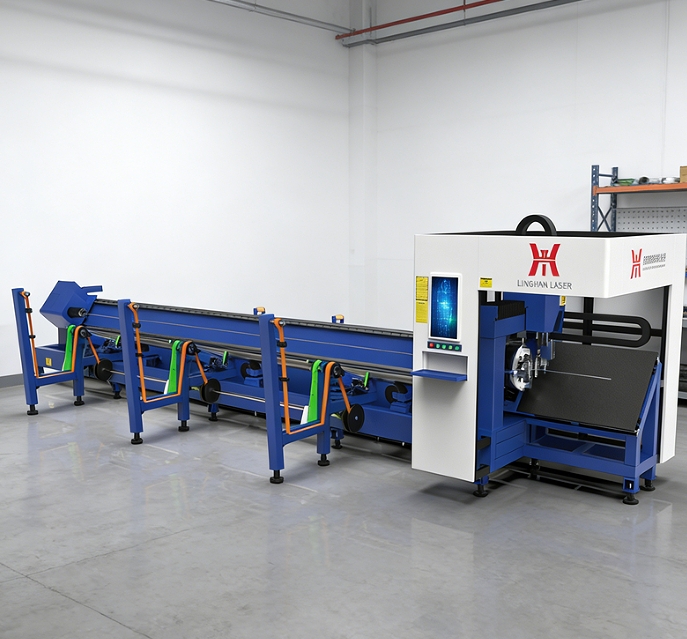
Standard Diameter Range for CNC Laser Tube Cutters
Round Tube Diameter Limits: 10 mm to 500 mm (and Beyond with High-End Systems)
Industrial-grade CNC laser tube cutters typically process round tubes from 10 mm to 500 mm in diameter. High-precision systems with advanced optics and motion control can exceed 500 mm for specialized applications—though cutting stability declines beyond this threshold due to beam divergence and thermal distortion.
Chuck configuration is the primary mechanical enabler of this range: dual-chuck systems generally support up to 200 mm, while four-chuck designs provide the rigidity required for stable 500 mm operations. Industry benchmarks categorize capacity as follows:
- Standard systems: 10–300 mm
- Heavy-duty configurations: 300–500 mm
- Custom high-end solutions: 500+ mm
How Wall Thickness and Material Type Jointly Constrain Maximum Diameter
The maximum diameter that works well isn't just about one factor but comes down to how wall thickness interacts with material thermal properties and available laser power. Take carbon steel for example it has good thermal conductivity around 45-50 W/m·K which allows for bigger diameters like 500 mm when walls are 12 mm thick. Stainless steel tells a different story though. With lower conductivity (only 15-20 W/m·K) plus higher thermal expansion rates (about 17.3 µm/m·K compared to carbon steel's 10.8 µm/m·K), most precision work stays below 400 mm at similar wall thicknesses. Aluminum presents another challenge altogether. While it conducts heat extremely well (around 235-237 W/m·K), manufacturers need to clamp parts carefully because aluminum expands so much more than other metals (expansion coefficient of 23.1 ×10⁻⁶/°C). This expansion often causes dimensional changes during long cutting operations, making proper fixturing absolutely essential for maintaining accuracy.
Thicker walls (>8 mm) reduce maximum stable diameter by 15–30% across all materials, while higher laser power extends reach: a 12 kW system achieves 500 mm on carbon steel at 8 mm wall thickness, where a 6 kW system caps at ~400 mm.
Clamping System Architecture and Its Role in Diameter Capacity
Four-Chuck vs. Dual-Chuck Designs: Precision, Stability, and Effective Diameter Envelope
How the clamping system is set up determines what size parts can be handled. Four chuck systems work by making contact all around the circumference of the part, which helps cut down on vibrations during operation. These setups can maintain position accuracy within about 0.1 mm even for pieces larger than 500 mm in diameter. On the other hand, dual chuck systems are designed more for speed than stability, but they usually max out around 300 mm because bigger parts tend to flex and cause measurement errors, especially with thick walls or large diameters. Research published in laser processing journals shows that four chuck arrangements provide roughly 45% better torsional stiffness compared to their dual counterparts. This matters a lot when working with structural tubing that has thick walls at the maximum size range.
Adaptive Chuck Technology for Mixed-Diameter Nesting and Uninterrupted Feeding
Modern self adjusting chucks work with servo driven jaws plus real time pressure sensors to change how they grip things on their own. These systems can switch from holding small stuff like 20mm pipes to big structural pieces at 450mm diameter almost instantly. No need for operators to mess around between different parts means factories save time and space when arranging work sequences, often getting about 30% better efficiency out of their setup. The way these chucks distribute force is pretty smart too. They stop thin walled tubes from getting squashed out of shape while keeping good hold even when switching between materials. This matters a lot in shops where they make all sorts of different products but not many of each run.
Cross-Sectional Shape and Its Impact on CNC Laser Tube Cutter Diameter Limits
Why Round Tubes Achieve Larger Diameters Than Square, Rectangular, or Oval Profiles
Round tubes naturally offer better diameter capacity because of their rotational symmetry and how they spread out stress evenly. The circle shape lets clamping forces work uniformly all around the tube, which cuts down on slippage and deformation problems important for stable operations at 500 mm sizes. Square and rectangle shaped tubes are different though. They tend to focus clamping stress right at the corners, so most people don't go beyond about 360 mm sides before running into fixture stability issues or corners popping up during processing. Oval shapes bring extra complications too. Their uneven weight distribution makes it harder to align with chucks properly, and those thinner walls can actually collapse when exposed to concentrated laser heat. Round tubes also make life easier for the laser head movement since there's no need for constant direction changes required with angular profiles. Plus, they help dissipate heat more evenly across the surface area, which means less warping compared to flat areas found in big rectangular sections where this problem gets worse.
Material-Specific Thermal Behavior and Diameter Constraints
Stainless Steel, Aluminum, and Carbon Steel: How Thermal Conductivity Affects Max Stable Diameter
When it comes to setting diameter limits during laser cutting, thermal conductivity plays king of the hill compared to other factors like melting point or hardness. Take aluminum for instance, with its impressive conductivity rating around 237 W/m·K, it spreads out the heat from lasers pretty quickly. This allows for stable cuts all the way up to approximately 300 to 350 mm before things start getting distorted by heat buildup. Stainless steel tells a different story though. Its much lower conductivity range of about 15 to 20 W/m·K means heat gets trapped right along that cut line, making warping a real concern once we go past roughly 150 to 200 mm without some serious cooling intervention. Carbon steel falls somewhere in between these extremes at around 45 to 50 W/m·K. Standard setups can handle pieces up to about 250 to 300 mm, but what actually works best often hinges on specific carbon content levels and how aggressive the cooling methods are applied.
The expansion coefficients really affect these operational boundaries. Take aluminum for instance, with its pretty high coefficient of 23.1 ×10⁻⁶ per degree Celsius. This means operators need to apply very precise and constantly adjusting clamping forces during cutting operations to compensate for thermal expansion happening right in the middle of the cut. Stainless steel isn't much better either, expanding at around 17.3 ×10⁻⁶/°C which actually makes bigger sections prone to warping and distortion problems. Carbon steel stands out because it has a much lower expansion rate at about 10.8 ×10⁻⁶/°C, making it generally more stable when working with larger components. When part diameters get close to what the system can handle, managing heat becomes absolutely critical. Manufacturers often turn to various cooling techniques like pulsed laser operation modes, compressed air assistance systems, or even active cooling mechanisms built into chucks themselves just to maintain those crucial dimensional tolerances throughout production runs.