
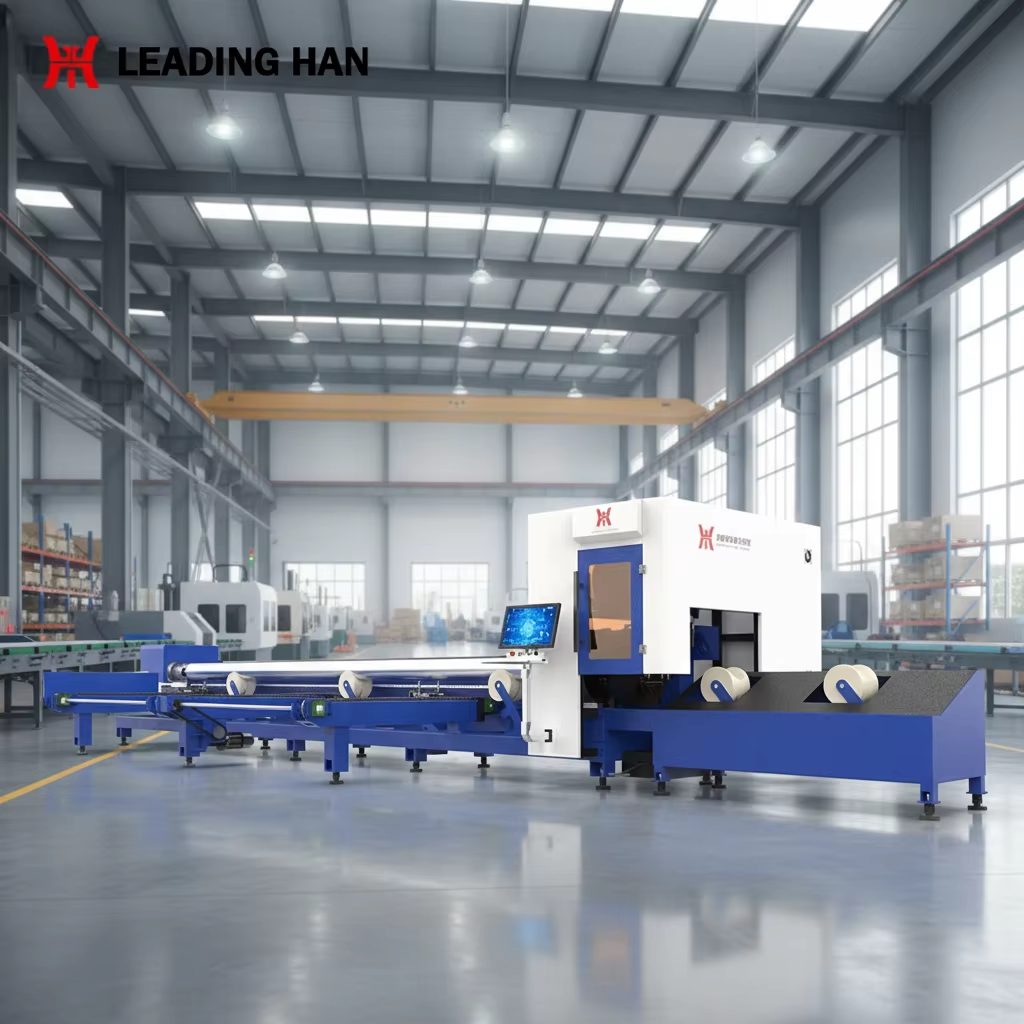
Core Material Compatibility: Mild Steel, Stainless Steel, Aluminum, Brass, and Copper
How the 1.06 µm Wavelength Improves Absorption in Reflective Metals
Fiber laser tube cutters work with a wavelength around 1.06 microns which helps them tackle the tricky reflective properties of metals such as copper and brass. Traditional CO2 lasers operate at about 10.6 microns instead, making them less effective against these materials. The much shorter wavelength used in fiber lasers actually connects better with metal surfaces at the atomic level. This means copper alloys absorb roughly 70 percent more energy when being cut, allowing for cleaner cuts without harming delicate optical components during operation. When it comes to brass tubes specifically, there's special programming called pulse modulation that controls how the laser pulses interact with the material surface. This prevents unwanted heat accumulation while still achieving those smooth, burr free edges that were almost impossible to get using older CO2 laser technology or other methods like plasma cutting and water jets.
Real-World Precision: Sub-0.1 mm Tolerance on Aluminum 6061 Tubing
Fiber laser technology for tube cutting can reach dimensional tolerances below 0.1 mm when working with aerospace grade aluminum 6061 tubing. This level of precision matters a lot because structural parts need to fit together perfectly. Even small deviations can lead to major problems during assembly. The machines accomplish this through features like adaptive focus control combined with adjustments to power output as they cut. They manage to keep kerf widths around 0.08 mm or less even on curved surfaces, something that remains consistent even when the cutting speed goes above 25 meters per minute. Nitrogen is used as an assist gas which helps prevent oxidation issues and gets rid of those annoying micro burrs that often form. Plus, since there's such a small heat affected zone, thin walled sections don't warp during processing. Manufacturers regularly hit around plus or minus 0.05 mm accuracy for complicated shapes, which meets all the tough requirements from both aviation and automotive industries without needing any extra finishing work afterward.
Advanced Alloys for High-Value Applications: Titanium, Nitinol, MP35N, and Pt-Ir
Meeting Medical Device Standards: Clean Cuts Without Microcracking or Oxidation
Fiber laser technology offers remarkable precision when cutting medical grade alloys like Grade 23 titanium (Ti-6Al-4V ELI), Nitinol, MP35N, and even expensive platinum-iridium combinations without damaging their structural integrity. The key lies in keeping the maximum power density below about 5 million watts per square centimeter while operating at pulse rates less than 1 kilohertz. This approach stops those tiny cracks from forming during stent production, which matters a lot when dealing with pricey Pt-Ir parts where any flaw can mean significant losses. According to ASTM standard F3001-14 guidelines, such cuts maintain crack occurrences below half a percent across 1,000 inspections. Special sealed gas chambers keep oxygen content down to less than one part per million, so there's no risk of oxidation affecting sensitive MP35N cobalt nickel alloys. Industry reports show most manufacturers achieve nearly perfect results too, with over 99.8% success rate on burr free femoral implants where heat affected zones stay under 20 micrometers thick.
Optimized Pulse Parameters and Assist Gas Strategies for Heat-Sensitive Tubes
When working with heat-sensitive materials such as beta-titanium (Ti-15V-3Cr-3Sn-3Al), getting the right pulse shape really matters if we want to prevent warping in those delicate thin wall tubes. By tweaking the pulse width between 0.1 and 1 millisecond and adjusting peak power levels from 2 to 6 kilowatts, manufacturers can keep local temperatures under control, staying below that critical 250 degree Celsius threshold. Switching to nitrogen assist gas at around 25 bar pressure cuts down on unwanted dross formation when dealing with copper nickel alloys, making for roughly 70 percent fewer problems compared to traditional oxygen based systems. For Nitinol applications, ultra pure argon shielding makes all the difference too. It maintains the material's shape memory properties so precisely that the phase transition temperature stays within just plus or minus 2 degrees Celsius, which is absolutely crucial for things like medical guidewires where performance cannot vary. All these carefully adjusted procedures result in processing times that are more than 30 percent quicker than standard approaches, yet still maintain tensile strength specs within about 5 percent of what the raw material originally offered.
Fiber Laser vs. CO2 Laser: Why Fiber Laser Tube Cutting Machines Dominate Metallic Applications
Physics of Reflection: Why CO2 Lasers Struggle with Copper and Brass
CO2 lasers work around the 10.6 micrometer range which most shiny metals just bounce right off. About two thirds of the energy gets reflected when these lasers hit copper or brass, which can cause problems for optics and lead to uneven cutting results. Fiber lasers tell a different story though. Their 1.06 micrometer beam interacts much better with metal atoms, getting through those reflective layers roughly five times faster than traditional options. This makes all the difference in practice since it stops dangerous reflections from happening and allows consistent quality when working with materials like brass and copper. For anyone dealing with tube cutting operations, fiber lasers have become practically essential equipment these days because they handle those tricky reflective surfaces so well.
Industry Adoption Trend: 78% Shift to Fiber Laser Tube Cutting Machines in Automotive Tier-1 Suppliers
According to a recent industry report from 2024, about three quarters of top tier automotive parts makers have switched over from traditional CO2 lasers to fiber laser tube cutters when working on things like exhaust manifolds, frame structures, and suspension parts. Why? Well, these new machines cut through stainless steel and aluminum tubes around 30 percent quicker than before. Plus they create almost no heat distortion problems with those delicate thin wall materials. And let's not forget the energy savings either - manufacturers are seeing roughly half the power usage compared to older CO2 systems. The shift makes sense when looking at what original equipment manufacturers demand nowadays. Fiber lasers just happen to deliver better dimensional stability, consistent edges across all cuts, and reliable results batch after batch. All this while keeping operational costs down significantly over time.
Consistent Precision, Edge Quality, and Minimal Heat-Affected Zone (HAZ)
Adaptive Focus and Real-Time Power Modulation for Uniform Kerf and Burr-Free Edges
What makes fiber laser tube cutters so precise? Adaptive optics combined with dynamic power control play a big role here. During cutting operations, the system constantly modulates laser intensity right in the middle of cuts. This prevents spots from getting too hot, which helps maintain the metal's structural properties while keeping the cut width consistent even when dealing with different shapes and sizes. Another key feature is how the focus point shifts dynamically as materials get thicker or curved. This ensures the laser delivers just the right amount of energy where it's needed most. The outcome? Almost no heat affected zone around the cut area, metals like titanium retain their strength after processing, and edges come out clean enough for immediate assembly without extra work. Factories report cutting post processing time down by about 70% overall, which speeds things up considerably in industries such as aerospace manufacturing, medical device fabrication, and performance car parts production.
FAQ
What wavelength do fiber laser tube cutters operate at?
Fiber lasers operate at around 1.06 microns, which helps in cutting reflective properties of metals like copper and brass effectively.
How does fiber laser technology benefit aluminum 6061 tubing?
Fiber lasers achieve sub-0.1 mm tolerance in aluminum 6061 tubing, offering precision and maintaining structural integrity without the need for additional finishing.
Why are fiber lasers preferred over CO2 lasers in metallic applications?
Fiber lasers dominate metallic applications due to their ability to interact better with metal atoms and handle reflective surfaces like brass and copper effectively.
What materials can be cut using fiber laser technology?
Materials such as Mild Steel, Stainless Steel, Aluminum, Brass, Copper, Titanium, Nitinol, MP35N, and Pt-Ir can be precisely cut using fiber laser technology.
What industries benefit from fiber laser tube cutting?
Industries such as aerospace, automotive, medical device fabrication, and more benefit from fiber laser tube cutting due to its precision and efficiency.
Table of Contents
- Core Material Compatibility: Mild Steel, Stainless Steel, Aluminum, Brass, and Copper
- Advanced Alloys for High-Value Applications: Titanium, Nitinol, MP35N, and Pt-Ir
- Fiber Laser vs. CO2 Laser: Why Fiber Laser Tube Cutting Machines Dominate Metallic Applications
- Consistent Precision, Edge Quality, and Minimal Heat-Affected Zone (HAZ)
-
FAQ
- What wavelength do fiber laser tube cutters operate at?
- How does fiber laser technology benefit aluminum 6061 tubing?
- Why are fiber lasers preferred over CO2 lasers in metallic applications?
- What materials can be cut using fiber laser technology?
- What industries benefit from fiber laser tube cutting?